

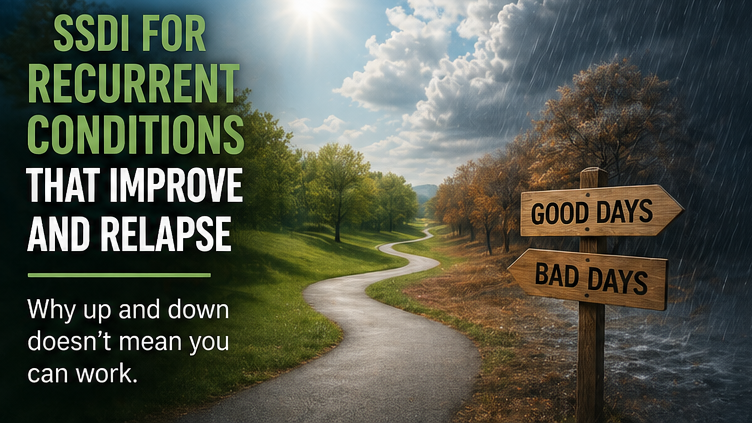
Some of the most disabling conditions are not constant. They improve, then return. They stabilize briefly, then flare again.
This pattern creates confusion for SSDI applicants and often leads to denial.
SSA does not deny claims simply because a condition fluctuates. But it does require a clear explanation of how those fluctuations affect your ability to work.
The Core Issue Is Reliability
SSA is not asking whether you can function occasionally. It is asking whether you can function consistently.
Relapsing conditions interfere with:
- Attendance
- Productivity
- Scheduling
- Task completion
Even if symptoms improve temporarily, the unpredictability itself can make work impossible.
Common Conditions That Follow This Pattern
- Autoimmune disorders
- Multiple sclerosis
- Long COVID
- Severe migraines
- Mental health conditions
- Chronic fatigue syndromes
These conditions often involve cycles that are not visible in a single medical visit.
Why SSA Misinterprets Improvement
Medical records often include terms like:
- Improved
- Stable
- Responding to treatment
SSA may interpret these as recovery.
In reality, they often reflect temporary relief within a larger pattern of relapse.
What SSA Actually Needs to See
To approve these cases, SSA must understand:
- How often flare-ups occur
- How long they last
- How severe they are
- How long recovery takes
The entire cycle must be documented.
How to Build a Strong Case
Winning claims include:
- Longitudinal medical records
- Symptom tracking logs
- Documentation of missed work or activity
- RFC forms reflecting worst periods
- Clear explanation of cycles
The focus is not on isolated improvement, but on overall sustainability.
Why These Cases Win at Hearings
Judges tend to better understand fluctuating conditions because:
- They evaluate long-term patterns
- They hear detailed testimony
- They consider real-world work expectations
When the full cycle is explained clearly, many previously denied cases are approved.
⚖️ Final Takeaway
Temporary improvement does not equal ability to work. If your condition repeatedly disrupts your functioning, you may still qualify for SSDI.
📞 Call to Action
Free case review for fluctuating conditions
We document cycles that SSA often misses
No fees unless you win