
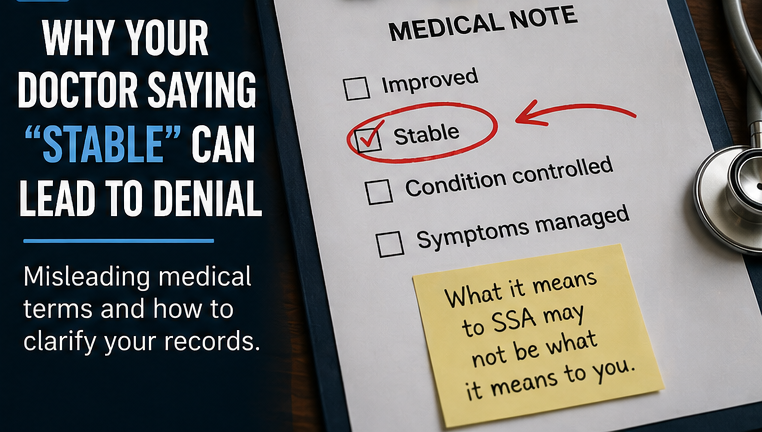
The word “stable” seems harmless. In medical settings, it often means your condition is not getting worse.
In SSDI claims, that same word can quietly destroy your case.
What Doctors Mean by “Stable”
In clinical terms, “stable” usually means:
- No immediate deterioration
- Symptoms are consistent
- No urgent intervention required
It does not mean:
- You are functioning well
- You can work
- You are symptom-free
What SSA Thinks It Means
SSA often interprets “stable” as:
- Condition controlled
- Symptoms manageable
- Functional ability intact
This disconnect creates serious problems.
How This Leads to Denials
If your records repeatedly state “stable,” SSA may conclude:
- Your condition is not severe
- Treatment is effective
- Work is possible
Even when you are struggling daily.
The Bigger Problem: Missing Context
Medical notes often lack:
- Functional limitations
- Work-related restrictions
- Detailed symptom descriptions
Without that context, SSA fills in the gaps with assumptions.
How to Fix This Issue
You do not need to challenge your doctor. You need to clarify the record.
Ask your provider to include:
- Ongoing symptoms
- Functional limits
- Impact on daily activities
- Work-related restrictions
An RFC form can be especially powerful here.
Better Documentation Example
Instead of:
“Patient is stable”
A stronger note would be:
“Patient’s condition remains chronic with persistent symptoms that significantly limit stamina, concentration, and ability to sustain work activity”
Why This Matters at Every Stage
From initial application to hearing, SSA relies heavily on written records.
A single word can influence how your entire case is interpreted.
⚖️ Final Takeaway
“Stable” does not mean able to work. But unless your records explain that clearly, SSA may assume otherwise.
📞 Call to Action
- Free medical record review
– We identify language that weakens your claim
– No fees unless you win