

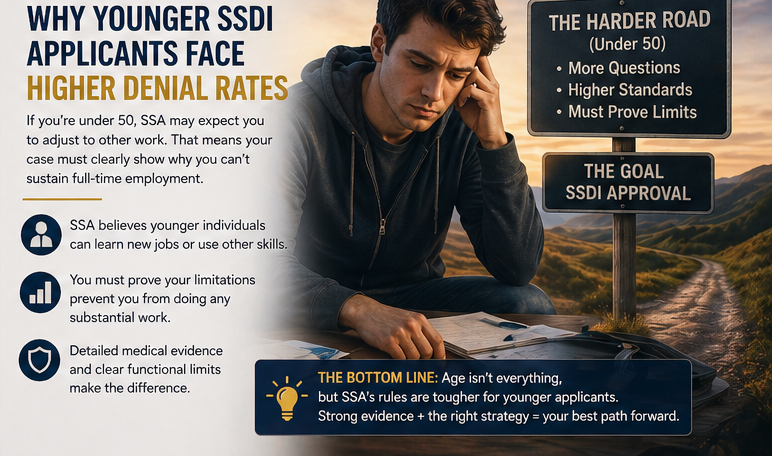
Age plays a significant role in SSDI decisions, even though it is not always obvious at first glance. Many younger applicants are surprised to learn that their cases are often held to a different standard than those of older individuals.
This does not mean that younger people cannot qualify for SSDI. It means that the path to approval is often more demanding.
SSA uses a framework that considers whether a person can adjust to other types of work. Younger individuals are generally expected to adapt more easily to new roles, even if they can no longer perform their previous job. This assumption creates a higher barrier.
For someone under fifty, SSA is more likely to argue that:
- Skills can transfer to different work
- New types of jobs can be learned
- Physical limitations can be accommodated in alternative roles
As a result, the focus shifts heavily toward functional limitations. It is not enough to show that you cannot do your past work. You must show that you cannot reliably perform any full-time work that exists in significant numbers.
This is where many claims fall short. The evidence may establish a diagnosis and even some limitations, but it does not clearly demonstrate the inability to sustain work across different environments.
Younger applicants often need more detailed documentation of:
- Physical endurance
- Mental stamina
- Ability to concentrate
- Attendance reliability
- Need for breaks or rest
Even small limitations can have a significant impact when combined, but they must be clearly articulated.
Another challenge is perception. There can be an unspoken bias that younger individuals should be able to recover, adapt, or push through difficulties. Overcoming this requires consistent medical evidence and a clear narrative that explains why the condition is not temporary.
The good news is that many younger applicants are approved at the hearing level, where judges take a more detailed look at the full record. When limitations are clearly connected to real-world work demands, the argument becomes much stronger.
⚖️ Final Takeaway
Being younger does not prevent SSDI approval, but it does require stronger and more detailed proof of functional limitation.
📞 Call to Action
If you are under fifty and facing denial, your case may need a different strategy.
Call for a free SSDI review
We build stronger cases for younger applicants
No fees unless you win