

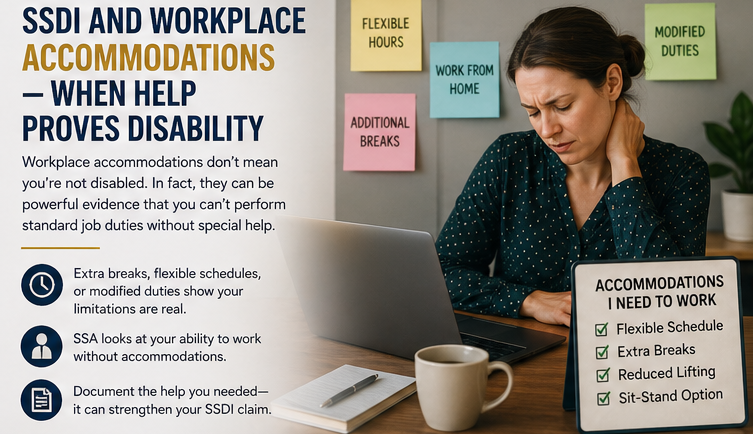
Many people hesitate to apply for SSDI because they received accommodations at work. They assume that if an employer made adjustments to help them stay employed, it means they are not truly disabled.
This assumption is not only incorrect, it often causes applicants to overlook some of the strongest evidence in their case.
Workplace accommodations can actually demonstrate that your ability to function depended on support that is not available in most competitive jobs.
Social Security does not evaluate whether you can work under ideal or modified conditions. It evaluates whether you can perform full-time work under standard expectations in the national economy. That distinction is critical.
When an employer allows extra breaks, flexible hours, reduced productivity, or modified duties, they are effectively acknowledging that you cannot meet normal work requirements. These adjustments are often made informally and may not even be documented clearly, but they represent a gap between your actual capacity and typical job expectations.
The problem arises when this context is missing from your SSDI application. If SSA sees that you continued working, even with accommodations, it may assume that you retained full functional ability. Without explanation, accommodations can be misinterpreted as evidence against disability rather than proof of it.
The key is showing that your ability to remain employed was conditional. Perhaps you were allowed to sit when others stood, take unscheduled breaks, arrive late due to symptoms, or work at a slower pace. These are not minor conveniences. In most workplaces, they would not be tolerated on a consistent basis.
Another important factor is sustainability. Many individuals who receive accommodations still experience decline over time. They may reduce hours, miss increasing amounts of work, or ultimately leave employment because even the accommodations were no longer enough. This progression is powerful evidence of disability when it is properly documented.
Judges often view accommodations as a sign that an employer attempted to retain a valuable worker despite clear limitations. It reflects effort, not ability. When framed correctly, it strengthens both credibility and the overall narrative of decline.
The challenge is that accommodations must be translated into functional limitations. It is not enough to say you had flexibility. The case must show what would happen without that flexibility, and why standard work expectations would not be possible.
⚖️ Final Takeaway
Workplace accommodations do not weaken your SSDI claim. They often prove that you could not meet normal job demands without special support.
📞 Call to Action
If you worked with accommodations before stopping, your case may be stronger than you think.
Call for a free work capacity review
We translate accommodations into legal proof
No fees unless you win