

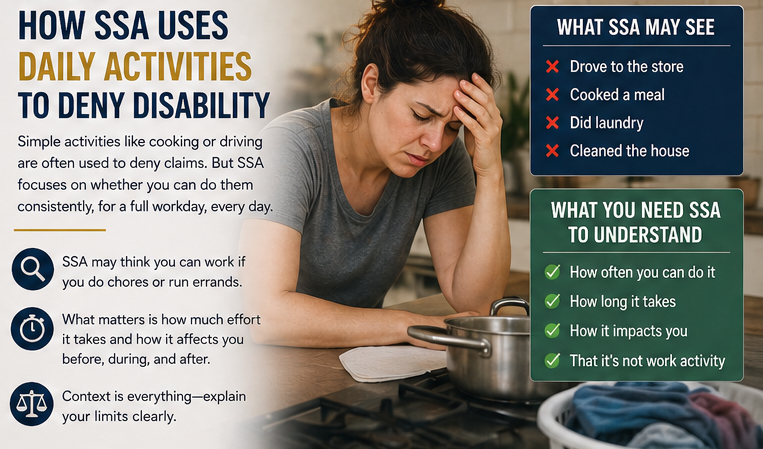
One of the most frustrating parts of the SSDI process is how everyday activities are interpreted. Tasks like cooking, driving, or doing light household chores often appear in denial letters as evidence that a person can work.
To most applicants, this feels disconnected from reality. Being able to prepare a simple meal or drive occasionally does not resemble the demands of full-time employment. Yet SSA frequently uses these activities to question the severity of a claim.
The issue lies in how these activities are recorded and interpreted. When you complete disability forms or speak with a doctor, you may say that you can cook or clean. What is often missing is the context. You might need to take breaks, perform tasks slowly, or only complete them on certain days. Without that detail, the activity appears normal and consistent.
SSA is not simply looking at whether you can perform a task once. It is evaluating whether you can perform similar tasks repeatedly, efficiently, and without interruption. The difference between occasional ability and sustained capacity is where many cases are misunderstood.
Daily activities become problematic when they are described in broad or optimistic terms. For example, saying you can do laundry may be interpreted as lifting, standing, bending, and completing tasks independently. In reality, you may need help, take extended time, or experience pain during and after the activity.
Another issue is that people often present themselves differently in different settings. In medical visits, they may minimize symptoms. In forms, they may provide limited detail. At hearings, they may describe their limitations more fully. These inconsistencies create doubt, even when the underlying condition is legitimate.
The key is not to eliminate daily activities from your narrative. It is to describe them accurately. What matters is how long tasks take, how often they can be done, and what happens afterward. If an activity leaves you exhausted or in pain for hours, that is highly relevant to your ability to work.
Judges understand that basic self-care does not equate to employability. However, they rely on the record to make that distinction. When the record lacks detail, SSA fills in the gaps with assumptions that often lead to denial.
⚖️ Final Takeaway
Daily activities do not prove you can work. But without context, they can be used to suggest that you can.
📞 Call to Action
If your daily activities were used against you, your case may need reframing.
Call for a free case review
We correct how SSA interprets your routine
No fees unless you win